The David Vases: A Temple Offering That Helped Date Chinese Blue-and-White Porcelain
2026-11-25
The words on the necks of the David Vases were not written for an art historian. They were a prayer for a family.
A man named Zhang Wenjin had a pair of porcelain vases and an incense burner offered to a temple. He wanted good fortune for his household and safety for his children. The dedication also recorded when the offering was made: the fourth month of the eleventh year of the Zhizheng reign, equivalent to 1351.
Centuries later, that date gave researchers something unusually firm to hold on to. The two blue-and-white vessels were already known as impressive works of Chinese porcelain. Their inscriptions helped establish that sophisticated porcelain of this kind was in use during the Yuan dynasty, before the better-known Ming dynasty began.
A prayer written on porcelain
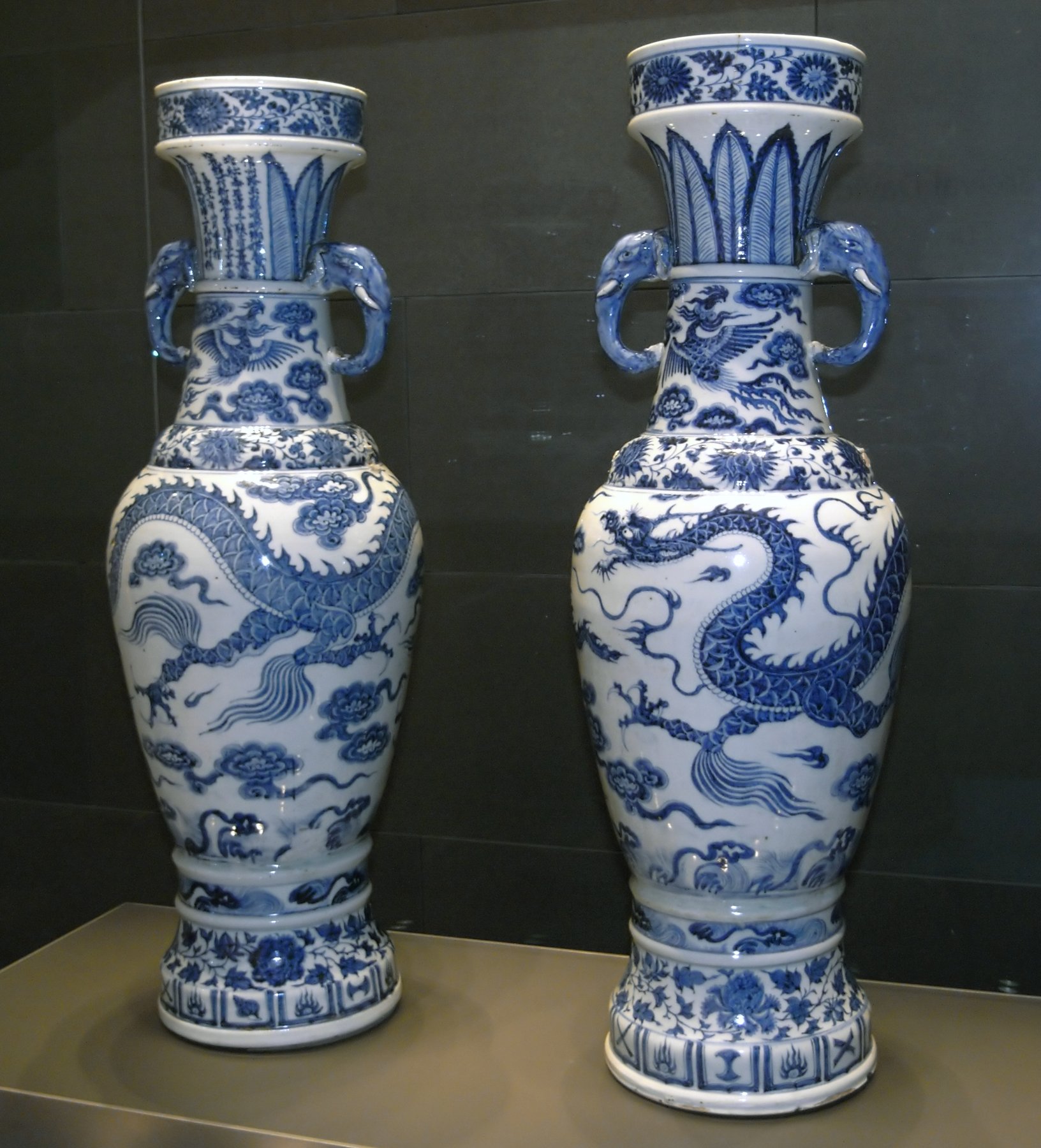
The two vases are tall enough to make their decoration easy to notice before their writing. Each stands roughly 64 centimetres high, with elephant-head handles and a dragon moving through clouds across the broad body. Peonies and other plant forms fill further bands above and below.
On each neck, however, a column of Chinese writing interrupts the decoration. It names Zhang Wenjin, gives his home district, lists his offering and records his wishes for his family. The inscriptions are closely related, although their wording is not identical in every detail.
The dedication expresses Zhang’s hope for the well-being of his family. It is a small window into an occasion that might otherwise have been lost. Zhang was not leaving instructions for future collectors. He was identifying an act of devotion and the people he hoped it would benefit.
The name of a local religious figure also appears in the dedication: Marshal Hu Jingyi. The vases were intended for a temple altar, where the pair and the burner would have formed an offering rather than a display chosen simply for their appearance. The British Museum identifies the temple setting as Daoist.
The inscription does not tell us everything we might want to know. It gives Zhang’s name and place, but it does not provide a full biography. The original altar arrangement is not preserved with the vases, and the location of the incense burner named in the dedication is unknown.
Why was the 1351 dedication so useful?
The date belongs to the dedication. It tells us that the vases were in existence for the offering in 1351; it does not, by itself, tell us the exact day the potters shaped or fired them.
That distinction does not make the inscription less useful. Many surviving ceramics have no date written on them at all. Researchers often compare their shapes, decoration, manufacturing features and archaeological contexts to propose a date. The David Vases provide a rare point of comparison: two vessels with a date and a purpose recorded on the objects themselves.
The British Museum’s catalogue identifies the vases as porcelain made at Jingdezhen in Jiangxi province. Zhang’s home district and the temple named in the dedication were also in the Jiangxi region. A piece of writing on the vessels therefore connects their decoration to a particular time and to people using porcelain in a specific place.
For students of Chinese ceramics, the result is more helpful than a label saying only “old.” If a group of other objects shares meaningful features with the David Vases, the pair offers one point from which to begin comparing them. A resemblance, however, is not an automatic birth certificate: other evidence is still needed to decide when and where another vessel was made.
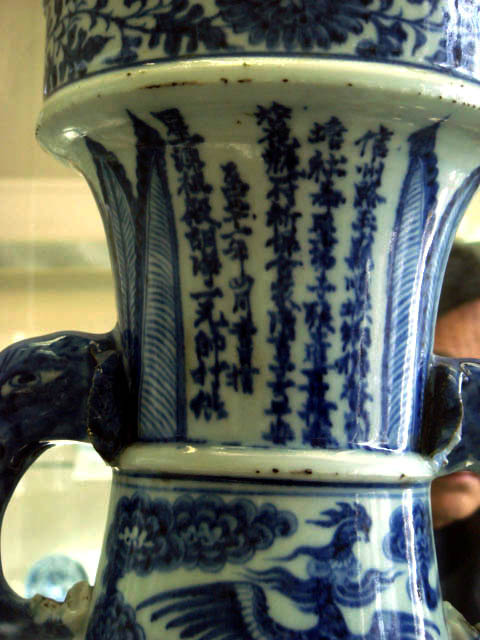
Image Source: Koh Antique
The blue-and-white question
The date was especially important because of what was painted on the vases. Their blue designs were applied beneath the glaze, which gives the vessels the familiar blue-on-white appearance that later became so widely associated with Chinese porcelain.
The Zhizheng reign belonged to the Yuan dynasty. The vases therefore show that this accomplished blue-and-white porcelain existed before the Ming dynasty, which began in 1368. They were not simply later Ming vessels with an early-looking shape.
That does not mean that Zhang’s pair was the first blue-and-white porcelain ever made. The inscription establishes a dated example, not the moment a technique was invented. It also cannot prove that every object painted with a similar shade of blue came from the same workshop or was made in the same year.
Those limits are worth keeping in mind because the vases are sometimes described as if their inscription answered the whole history of blue-and-white. Its real achievement is more specific: it anchors an impressive pair to the Yuan period and gives comparisons with other ceramics a much stronger starting point.
How scholars used the David Vases to study other ceramics
In the twentieth century, researchers began to build a clearer picture of early Chinese blue-and-white ware. The vases mattered because their inscriptions could be read alongside the designs and forms of other surviving objects.
The British Museum curator R. L. Hobson published a study of the dated Yuan vases in 1929. Yet recognition of the pair’s date did not instantly resolve the dates of every comparable piece. Researcher Sarah Wong’s study of early collectors shows that identification remained uneven: even when the vases’ date was understood, other large blue-and-white vessels could still be assigned to later periods.
A further comparison came from the American scholar John A. Pope. His 1952 study examined Chinese blue-and-white porcelain in the Topkapı Palace collection in Istanbul, and his later work considered pieces from the shrine collection at Ardabil in Iran. The dated David Vases provided an important reference point for thinking about related wares preserved far from the Jiangxi temple.
This was not a matter of reading a date on one object and declaring every similar vase identical. It was a process of examining groups of vessels and asking which resemblances were convincing. The inscriptions helped make that conversation possible; the comparison still depended on careful looking and further research.
How the temple vases became the David Vases
The name by which the pair is now known comes from a much later owner. Sir Percival David, a collector of Chinese ceramics, acquired the vases separately and brought them together in his collection. Their matching dedication helped show why they belonged as a pair.
Between the fourteenth-century offering and their appearance in twentieth-century collections, much of their journey is uncertain. The temple named in the inscription should not be confused with an unverified story about where the vases may have been kept later. Nor does the surviving dedication explain exactly how the two vessels became separated before David acquired them.
David’s collection became a resource for the study of Chinese ceramics. In 2009 it went on loan to the British Museum, where the David Vases could be seen by visitors alongside other works from the collection.
Today the two vessels can be approached in more than one way. Their blue dragons and elephant handles reward a close look. Their date helped researchers understand a chapter in the history of porcelain. But the lines on their necks also preserve something more personal: Zhang Wenjin’s wish that his family and children would be safe.
References
- BBC News. (2024, November 13). British Museum given its most valuable gift ever. https://www.bbc.com/news/articles/cvg0qxxgnnjo
- British Museum. (n.d.-a). Altar-vase: One of the David Vases [Collection record, PDF,B.613]. https://www.britishmuseum.org/collection/object/A_PDF-B-613
- British Museum. (n.d.-b). Altar-vase: One of the David Vases [Collection record, PDF,B.614]. https://www.britishmuseum.org/collection/object/A_PDF-B-614
- British Museum. (n.d.-c). The David Vases [Museum object description]. Google Arts & Culture. https://artsandculture.google.com/asset/the-david-vases/dgEjTbxKC2D5mA?hl=en
- British Museum & BBC. (n.d.). The David Vases [Object entry]. BBC, A History of the World. https://www.bbc.co.uk/ahistoryoftheworld/objects/nEO59KLxRoGD4hW9LD-L_g
- Iconotheca. (2026, August 18). The David Vases (1351 CE): Provenance, owners and auction record. https://iconotheca.com/artworks/jingdezhen-yuan-kilns/david-vases-british-museum/
- Pope, J. A. (1952). Fourteenth-century blue-and-white: A group of Chinese porcelains in the Topkapu Sarayi Müzesi, Istanbul. Freer Gallery of Art, Smithsonian Institution. https://babel.hathitrust.org/cgi/ssd?id=mdp.39015074805915
- Wong, S. (2025). The Yuan lacuna: The ‘David’ vases and UK collectors of early Chinese blue-and-white porcelain in the early 20th century. Journal of International Ceramic Studies, 1(1), Article 100007. https://doi.org/10.1016/j.joics.2025.100007