The Dragoon Vases: When Chinese Porcelain Crossed Between Two Kings
2026-11-24
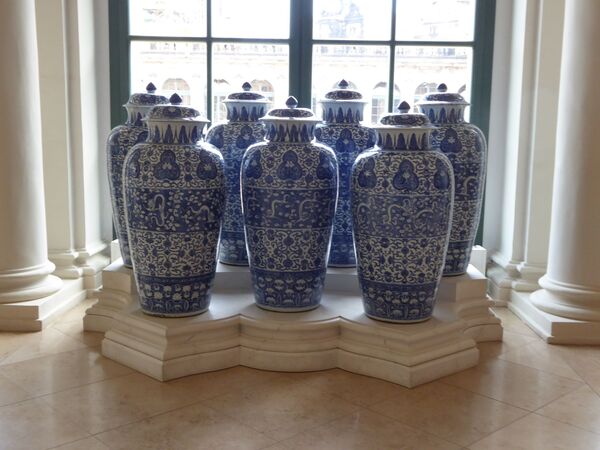
A Chinese porcelain jar in the Dresden collection stands just over a meter high, from its foot to the knob on its lid. Its surface is divided into bands of blue and white: flowers and curling leaves give way to pale, hornless dragons moving across a dark ground.
The museum records it as PO 1010, a covered jar made in Jingdezhen around 1700. It also identifies the piece with a group that acquired an unexpected name in Europe: the Dragoon Vases.
The name does not come from a battle painted on the porcelain. It recalls a transaction between two rulers in 1717, when a shipment of Chinese ceramics traveled from Prussia to Saxony and hundreds of Saxon cavalrymen entered Prussian service. The jar’s journey brings an extravagant collecting story into view—but also a human exchange that no decorative pattern can make comfortable.
What makes PO 1010 a Dragoon Vase?
PO 1010 was made during the Kangxi reign of China’s Qing dynasty. Its sides rise from a foot ring, widening toward a rounded shoulder before narrowing at the neck. The Dresden catalogue gives its height as 103.1 centimeters with the cover, or 91 centimeters without it.
The jar’s decoration rewards a closer look. Bands of lotus scrolls and interlacing plants alternate with gourd-shaped panels. One broad register carries chilong: hornless dragons reserved in white against cobalt blue. The different bands give the large surface a rhythm that remains visible at a distance, while the small details invite a viewer to come closer.
A jar of this size was not a small piece of tableware. Its material, scale and decoration made it a conspicuous object for display. The Dresden catalogue identifies PO 1010 as one of the porcelain objects acquired by Augustus the Strong from Frederick William I of Prussia in the 1717 exchange.
That is a claim about this particular jar’s recorded collection history. The term “dragoon vase” also came to be used more broadly for large Chinese export vases of comparable form. A vase called a soldier or dragoon vase is not necessarily one of the objects transferred in 1717.
The porcelain room that caught a visitor’s attention
Before the exchange, many of the pieces associated with the story belonged to the Prussian royal collections. Oranienburg Palace, north of Berlin, had a porcelain chamber filled with blue-and-white East Asian objects. The display was meant to impress as a room, not merely as a series of individual pieces.
Augustus the Strong visited Oranienburg in 1709 for a meeting with two other rulers. His host was Frederick I, the Prussian king—not Frederick William I, the successor with whom the later exchange would be made. According to the Prussian Palaces and Gardens Foundation, the porcelain chamber was among the palace’s showpieces.
Eight years later, Augustus was seeking impressive Asian porcelain for an ambitious display in Dresden. He was Elector of Saxony and also King of Poland, and collecting was one way of presenting the wealth and taste of his court. His own interest in porcelain was so intense that he associated it with the phrase maladie de porcelaine—porcelain sickness.
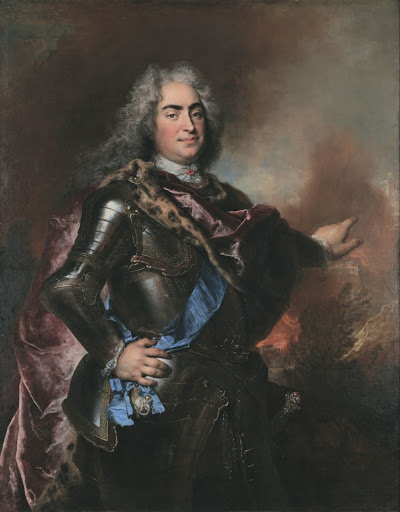
Image Source: The Nelson-Atkins Museum of Art via Google Arts & Culture
The portrait shows Augustus in armor, painted around the time he was building a collection of porcelain. It is a reminder that the collector and the military ruler were the same person, even if his Chinese jars and his soldiers are usually discussed in different rooms of a museum.
Why were soldiers exchanged for porcelain?
In 1717, Augustus and Frederick William I reached an arrangement remembered through the porcelain that traveled to Dresden. The Dresden Porcelain Collection summarizes it this way: “he swapped six hundred of his soldiers for 151 pieces of blue-and-white Chinese porcelain, among them thirty large vases.”
The numbers need care. 151 refers to the whole group of porcelain pieces, not to 151 enormous matching vases. The Dresden museum describes thirty large vases among them. The Prussian Palaces and Gardens Foundation identifies eighteen particularly tall Chinese floor vases from Oranienburg. Those descriptions do not establish that every large piece was identical, or that the two sources are counting exactly the same category of object.
The soldiers’ side also becomes less tidy when the familiar shorthand is examined. “Six hundred dragoons for vases” makes the exchange sound like a single ready-made unit traded for one uniform set of pots. Dresden’s object record describes approximately 600 cavalrymen who were formed into a Prussian dragoon regiment; it does not require us to assume that every man had previously served as a dragoon.
Nor should “exchange” suggest a shopping trip with a shelf price for an individual jar. The movement of the porcelain and the transfer of military personnel were connected in accounts of relations between the rulers. Details of the negotiations and the precise composition of the groups are more complicated than the nickname alone can convey.
For the men involved, a ruler’s decision meant a change of service. The surviving porcelain lets us see what arrived in Saxony; it does not tell us, by itself, what each transferred soldier thought about the arrangement.
From Prussian palaces to Augustus’s porcelain collection
The Dresden catalogue places PO 1010 among the wares associated with the Prussian transfer. Other Dresden museum records link the group to porcelain held at the palaces of Oranienburg and Charlottenburg near Berlin. For a vessel made in Jingdezhen, the passage between those two courts was only one part of a much longer journey from China to Europe.
Augustus already had an extraordinary appetite for East Asian porcelain. He had also supported the development of porcelain production in Saxony, eventually associated with the Meissen manufactory. Yet having a European source of porcelain did not make the older Chinese wares irrelevant to his collection. Their shapes, blue-and-white decoration and monumental scale remained valuable to him.
He planned a setting equal to that appetite. The Japanese Palace in Dresden was intended to bring East Asian and Saxon porcelain into an elaborate architectural display. The Dresden museum notes that the plans were not completed as intended before Augustus died in 1733.
PO 1010’s history is not simply a tale of an object passing from one hand to another. It moved between collecting schemes: from a Prussian palace display to a Saxon ruler’s much larger vision for porcelain. Later inventories, museum catalogues and the survival of the physical object allow researchers to follow parts of that story, while leaving other details less certain.
Where can the Dragoon Vases be seen today?
The Dresden State Art Collections preserve examples linked to the 1717 transfer, including the jar catalogued as PO 1010. Its catalogue entry identifies both its Chinese place of production and its association with Augustus’s acquisition. The Dresden Porcelain Collection is displayed at the Zwinger; individual objects may not always be on view, so a collection record is not a guarantee of what a visitor will see on a particular day.
The story also leads back to Oranienburg. The Prussian Palaces and Gardens Foundation says two of the tall vases are again part of the porcelain chamber there. Their presence offers a different view of the same history: pieces once associated with a Prussian royal collection can be encountered again in a setting connected to that collection.
Scholars continue to examine how the label “Dragoon Vases” developed and how later writers grouped the large vessels together. That work matters because a memorable name can make a complicated past appear settled. An attractive vase can look like a simple prize in a royal bargain; an inventory, a collection record and a history of military service bring the less convenient details back into the picture.
Standing before PO 1010—or reading its catalogue entry—we can follow the white dragons around its blue body and still ask a question that reaches well beyond the jar: how did an object made in China become entangled with the movement of soldiers between two European courts?
References
- Christie’s. (2019, June 17). A brief history of “soldier” vases. https://www.christies.com.cn/zh-cn/stories/a-brief-history-of-soldier-vases-ca59e7de098e40d1b5fd2cba609c7082
- The Nelson-Atkins Museum of Art. (n.d.). Augustus the Strong, Elector of Saxony and King of Poland [Painting by Nicolas de Largillière]. Google Arts & Culture. https://artsandculture.google.com/asset/augustus-the-strong-elector-of-saxony-and-king-of-poland-nicolas-de-largilli%C3%A8re/8wHDKmzc_yn-bw?hl=en
- The Pinnable Newsletter. (2019, December). The Dresden porcelain collection. https://pinnable.eu/article/dresden-porcelain-collection
- Schöneweiß, F. (2027). The provenance of monumental vases: Chinese porcelain, German curators, and global art history in Dresden since 1700. De Gruyter. https://doi.org/10.1515/9783689240592
- Staatliche Kunstsammlungen Dresden. (n.d.). About us: History of the collection. Porzellansammlung. https://porzellansammlung.skd.museum/en/about-us/
- Staatliche Kunstsammlungen Dresden. (n.d.). Covered jar, PO 1010 [Collection record]. The Royal Dresden Porcelain Collection. https://royalporcelaincollection.skd.museum/catalogue/1/object/2029?object=202900000123262
- Stiftung Preußische Schlösser und Gärten Berlin-Brandenburg. (n.d.). Oranienburg Palace / 1709: The meeting of three kings—Porcelain for soldiers. https://www.spsg.de/en/historic-places/oranienburg-palace-1709