The London Porcelain Factory That Called Itself ‘New Canton’
2026-11-26
In 1747, a London newspaper carried a confident promise from the Limehouse porcelain works: its new wares, the advertisement said, were “in no way inferior to China.” The sentence used the word China in two senses at once: a place and the porcelain that had become a prized import. A little later, another East London factory styled itself “New Canton,” borrowing the name of a port through which so much Asian trade passed.
Neither name made these wares Chinese. They were attempts by London makers to enter a market whose standard had been set by Chinese porcelain. A small Bow cup and a Limehouse tray, now in the Victoria and Albert Museum, show how that ambition appeared in objects—and why the factories’ experiments were more complicated than simply copying a pattern.
An advertisement that set the terms
The Limehouse advertisement was not a neutral description of material. It was a sales claim, asking buyers to judge English porcelain against an imported product they already valued. Chinese wares had travelled to Europe for centuries, and by the eighteenth century collectors and households prized them for their whiteness, strength, and varied forms.
The V&A’s account of blanc de Chine traces one part of that influence to Dehua, in Fujian. Dehua potters made a range of white ceramics from local clays; some pieces reached European markets and became models for European makers. “Blanc de Chine” was a European name for white porcelain from China, not the name of a single standardized recipe. A Dehua cup and an English imitation might look related while differing in body, glaze, and firing.
The advertisement specifically compared the durability of Limehouse wares with that of Chinese porcelain. That line tells us what the manufacturer hoped customers would believe, not whether the wares performed identically. A period advertisement is evidence of a market argument, not a laboratory comparison.
What “New Canton” meant in Bow
Bow was the first English factory built specifically to manufacture porcelain, according to the V&A’s account. From 1749 it used the name “New Canton,” invoking a major Chinese trading port. The name connected the factory to the prestige and commerce of Chinese porcelain while marking its goods as made in East London.
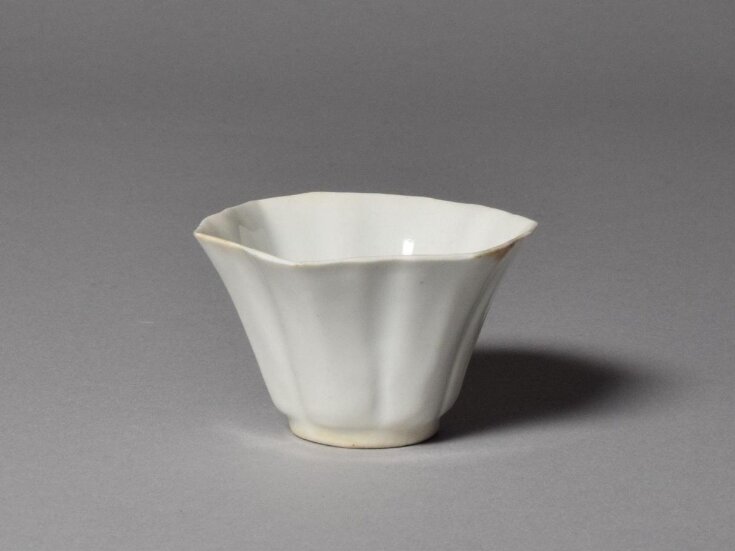
The V&A’s Bow cup, dated about 1750–55, is modest in scale: just 4.4 centimetres high. Its inverted-pyramid form is recorded as soft-paste porcelain. That small object is a useful counterweight to the grand language of “New Canton.” It is not a Chinese export vessel, but a London-made cup from a factory trying to establish a local porcelain industry.
The wider history of Chinese porcelain includes the correspondence of the French Jesuit François Xavier d’Entrecolles, who described aspects of Jingdezhen production. His letters offer a different record of how European readers sought knowledge about Chinese making. Bow’s factory was not simply reproducing a text or one Chinese object; its makers were working within a European industry trying to develop a dependable porcelain body and a saleable style. The difference was material as well as visual: the V&A records the Bow cup as soft-paste porcelain, while Chinese hard-paste porcelain depended on a different body and firing practice. A white surface alone therefore cannot tell us that two cups shared the same recipe.
A Limehouse tray, first given another identity
The nearby Limehouse factory left a different kind of object. The V&A catalogues a small soft-paste tray, probably made in London around 1745–48. It has the scalloped outline of a shell and a blue-painted landscape with two figures. The catalogue notes that it had previously been attributed to Bristol or Worcester and dated to 1752 before being reassessed as a likely Limehouse piece.
That change matters. “Chinese style” is not the same as “made in China,” and an object’s identity can shift when curators reconsider its form, materials, marks, or history. The tray’s underglaze-blue landscape draws on a visual language associated with Chinese ceramics, but the catalogue’s current attribution places its manufacture in London. The piece therefore records both imitation and local reinterpretation.
The two objects also warn against treating Bow and Limehouse as a single factory. They were separate businesses with different histories. The famous Limehouse advertisement belonged to a short-lived enterprise; Bow’s “New Canton” name belonged to a different maker. Both show that East London porcelain makers saw Chinese production as a benchmark and European imports as a market opportunity.
Limehouse’s own history makes the advertisement especially revealing. The V&A reports that the factory survived for only about three years; its experiments with design and production did not produce a lasting business. “Not inferior to China” was therefore a competitive claim, not the conclusion of a market or scientific comparison. The surviving tray helps anchor the claim in a real local workshop, while its later catalogue reattribution shows how easily the products of short-lived factories can be separated from their makers.
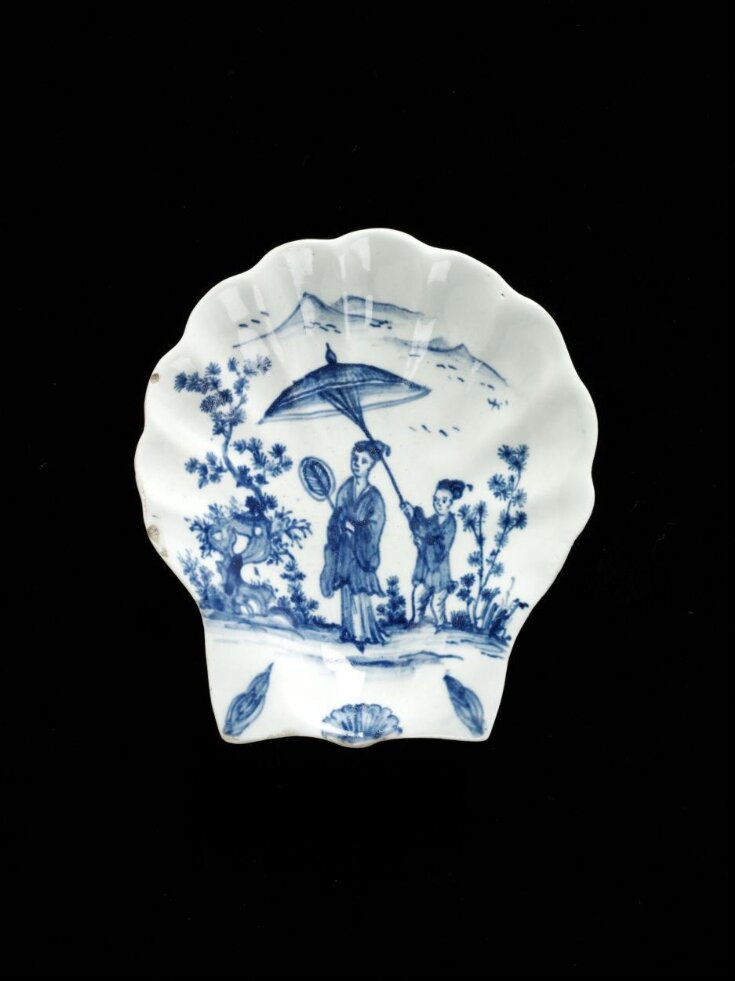
Image Source: Victoria and Albert Museum (Object C.535-1924).
How science changes the story
Modern research can examine the material itself rather than relying only on style or old catalogue labels. A multidisciplinary project involving the V&A, the Ashmolean Museum, and Newham Borough investigated the composition of selected eighteenth-century Bow and Chelsea porcelain objects. The project combined scientific analysis with community engagement and public workshops; its published account describes how heritage science helped explore the factories’ experiments with porcelain bodies. It brought together the V&A, the Ashmolean Museum, and Newham Borough, connecting object analysis to local histories and practical remaking activities.
That work does not mean every surviving cup can be assigned to a workshop by appearance alone. The study examined selected objects, not every cup or tray ever made in London, so its results should not be stretched into a universal test for Bow porcelain. The V&A’s Limehouse tray is a reminder that historic attributions can change. Nor does the phrase “New Canton” prove that Bow used a Chinese formula. It is evidence of branding and aspiration, not a recipe.
What survives is more interesting than a simple story of imitation. Chinese white and blue-and-white wares shaped European taste; London makers responded with their own materials, forms, and claims. The Bow cup is small, but it sits at the meeting point between imported Chinese porcelain and an emerging English industry. “New Canton” was an ambitious name for a factory still learning how to make its own version of porcelain.
References
Burgio, L., Domoney, K., Haseldine, G., & McCaffrey-Howarth, C. (2023). Making London porcelain—A multidisciplinary project connecting local communities with the technological and innovation histories of London’s early porcelain manufacturers. Heritage, 6(2), 1958–1976. https://doi.org/10.3390/heritage6020105
Tracey, O. (2026, April 28). East London porcelain and the world. V&A Blog. https://www.vam.ac.uk/blog/museum-life/east-london-porcelain-and-the-world
Victoria and Albert Museum. (2024, December 13). Blanc de Chine: White porcelain from China. https://www.vam.ac.uk/articles/blanc-de-chine-white-porcelain-from-china
Victoria and Albert Museum. (n.d.). Cup, Bow Porcelain Factory, about 1750–1755 (Object C.27-1928). https://collections.vam.ac.uk/item/O342003/cup-bow-porcelain-factory/
Victoria and Albert Museum. (n.d.). Pickle tray, Limehouse Porcelain Factory, about 1745–1748 (Object C.535-1924). https://collections.vam.ac.uk/item/O230465/pickle-tray-limehouse-porcelain-factory/