The Peacock Room: A Porcelain Collection, a Painter, and a Quarrel
2026-11-25
In an 1892 photograph of a London dining room, porcelain fills almost every space around the fireplace. Jars, plates and vases rise in rows of shelves, while a painted woman in a Japanese kimono looks out from above the mantelpiece.
The room’s owner, Frederick Leyland, had gathered a collection of blue-and-white ceramics for those shelves. The artist James McNeill Whistler had transformed the walls around them into a shimmering world of blue, green and gold. By the time the photograph was made, the two men had long since fallen out over the room.
The Peacock Room began as a place to display porcelain. Its decoration became the subject of a bitter quarrel—and its later journey to America would leave the original collection behind.
A London dining room built around Chinese porcelain
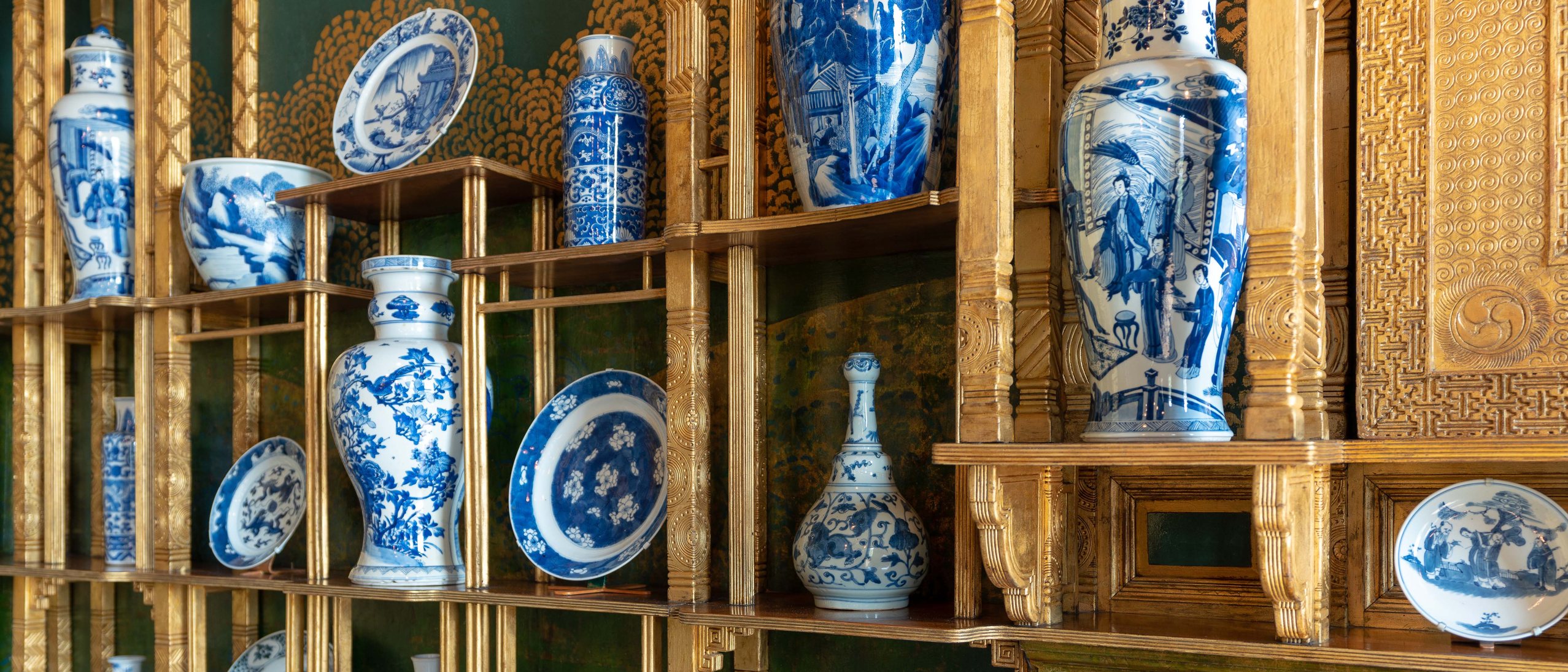
Leyland was a Liverpool shipping magnate with a passion for blue-and-white Chinese ceramics. Much of his collection dated to the Kangxi reign of the Qing dynasty, from 1662 to 1722. The shapes varied: dishes, jars and other vessels needed different spaces if they were to be displayed together.
For his London house at 49 Prince’s Gate, Leyland asked the architect and designer Thomas Jeckyll to create a dining room that would accommodate them. Jeckyll devised a lattice of walnut shelves across the walls, with each opening framing a piece of porcelain. Antique gilded leather hung behind the woodwork, bringing another layer of pattern to the setting.
This was not a room in which porcelain stood quietly on a single cabinet. The shelves made Leyland’s collection part of the architecture. A visitor’s eye could move from a tall jar to a shallow plate, and from the blue designs on a vessel to the lines of the shelving around it.
Over the fireplace hung Whistler’s painting The Princess from the Land of Porcelain. Its title suited the setting, although the picture is not a portrait of a Chinese porcelain maker. The painting shows a woman in Japanese dress amid objects and patterns that reflected the artist’s interest in Asian art.
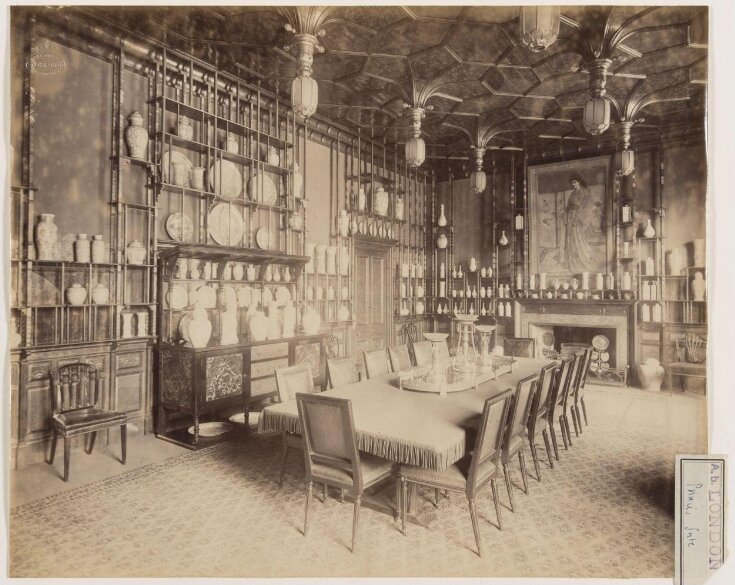
Image Source: Harry Bedford Lemere / Victoria and Albert Museum
Why did Whistler begin painting Leyland’s room?
Whistler was already working on the entrance hall of Leyland’s house when Jeckyll’s dining-room scheme neared completion. Jeckyll became ill, and Whistler offered advice about the room’s colours.
One problem, in Whistler’s view, was a set of red roses on the old leather wall hangings. He felt they conflicted with the colours in The Princess. Leyland agreed to a modest adjustment: Whistler could retouch those details and add a wave pattern to parts of the woodwork.
Then Leyland returned to Liverpool. During his absence, Whistler went much further.
He covered the ceiling with imitation gold leaf and painted it with peacock-feather patterns. The walnut shelving was gilded, while painted peacocks spread across the shutters. The changes gave the room a richer setting for the blue-and-white ceramics, but they went well beyond the small corrections originally discussed.
Whistler was delighted by what he was making. In a letter to Leyland, he described the dining room as “really alive with beauty” and urged his patron not to return before the work was complete. The artist saw the shelves, painting, walls and ceiling as parts of a single visual arrangement. Leyland had commissioned a room for his collection; Whistler increasingly treated the room itself as a work of art.
How a porcelain room became a dispute over art and money
The conflict was not simply a matter of whether blue and gold looked attractive. Whistler had altered a costly interior and received visitors and members of the press in Leyland’s house. The two men also disagreed over how much the work should cost.
According to the Smithsonian’s account, Whistler wanted 2,000 guineas. Leyland objected to the unexpected expense, writing, “I do not think you should have involved me in such a large expenditure without previously telling me of it.” He eventually paid £1,000—half the number Whistler had requested, but in pounds rather than guineas. Since a guinea was worth slightly more than a pound, the distinction mattered to the artist as well as the total.
Whistler answered with an image that made the disagreement part of the room. On the wall opposite The Princess, he painted two confronting peacocks. The Smithsonian interprets one bird, standing near a scatter of silver coins, as a reference to Leyland; the other, with a pale crest feather, recalls Whistler. The artist called the scene Art and Money; or, The Story of the Room.
The birds turn an argument over a private commission into something visitors can still see. Yet the porcelain was never merely a background to that quarrel. Leyland’s ceramics had helped determine why the shelves existed and what the room was meant to show. Whistler’s redesign changed the setting in which those objects would be seen.
What happened to Leyland’s porcelain after the quarrel?
Despite his disagreement with Whistler, Leyland did not strip the room back to Jeckyll’s earlier scheme. He kept it and continued to fill the shelves with porcelain until his death in 1892.
The Victoria and Albert Museum dates the photograph of the dining room to 1892: a table stands in the middle, and porcelain is arranged around the walls. Its record does not establish which particular pieces were still Leyland’s when the photograph was taken. What can be traced separately is the room itself: it eventually reached an American museum, but the collection that had first given its shelves a purpose did not travel with it as one intact group.
After Leyland died, his porcelain and other possessions were sold. The house initially failed to sell and was later purchased by another owner. Whistler’s Princess was sold separately, too. The pieces that had made the room a particular kind of dining room began to go their different ways.
The distinction can be easy to miss when a visitor sees porcelain on the Peacock Room’s shelves today. The vessels help evoke the room’s history, but their presence should not automatically be taken as proof that they belonged to Leyland.
How did the Peacock Room reach America?
In 1904, the American collector Charles Lang Freer bought the room after it had passed through other hands. It was dismantled and shipped across the Atlantic, and by 1906 it had been reassembled at his home in Detroit. Freer had acquired The Princess from the Land of Porcelain separately the previous year, so the painting and the decorated room could be brought together again.
Freer did not recreate Leyland’s shelves by transporting the London collector’s original porcelain collection. He filled the room gradually with ceramics from his own holdings. They came from places including China, Japan, Korea, Iran and Syria, making his installation a different gathering of objects from the predominantly Chinese blue-and-white display Leyland had assembled.
For Freer, those varied works belonged in conversation. He believed, as the Smithsonian later quoted him, that “all works of art go together, whatever their period.” The same room could express a collector’s idea without repeating the collection for which Jeckyll first designed it.
After Freer’s death in 1919, the room was moved again, this time to Washington, D.C. It became part of the Freer Gallery of Art, which opened to the public in 1923.
A room that can tell more than one porcelain story
The Peacock Room’s shelves have been arranged in different ways over time. In a 2019 installation, the museum brought back a predominantly blue-and-white appearance inspired by the Leyland years. It used historic Chinese porcelain from the Freer collection alongside newly commissioned ceramics—not the original Leyland collection reunited after its sale.
That changing display gives the room an unusual double life. Its walls preserve Whistler’s dazzling response to a collector’s china and to an argument with his patron. Its shelves can also introduce visitors to other ceramics and other collectors who came afterward.
A photograph from London and a later museum installation show the same painted room, but not the same collection. Looking at both makes the story richer: Chinese porcelain helped bring the Peacock Room into being, even as the objects on its shelves changed with each new chapter.
References
- MacDonald, M. F. (2014, May 27). The life, death and life of a room. James McNeill Whistler and His Art. https://jmcnwhistler.wordpress.com/2014/05/27/the-life-death-and-life-of-a-room/
- Smithsonian National Museum of Asian Art. (n.d.-a). A closer look: The Peacock Room. https://archive.asia.si.edu/exhibitions/online/peacock/default.htm
- Smithsonian National Museum of Asian Art. (n.d.-b). A closer look: The Peacock Room—Dispute over payment. https://archive.asia.si.edu/exhibitions/online/peacock/3.htm
- Smithsonian National Museum of Asian Art. (n.d.-c). A closer look: The Peacock Room—Whistler’s redesign. https://archive.asia.si.edu/exhibitions/online/peacock/2.htm
- Smithsonian National Museum of Asian Art. (n.d.-d). Harmony in blue and gold: The Peacock Room [Collection record]. https://asia-archive.si.edu/object/F1904.61/
- Smithsonian National Museum of Asian Art. (n.d.-e). The Peacock Room [Exhibition]. https://asia-archive.si.edu/exhibition/the-peacock-room-comes-to-america/
- Smithsonian National Museum of Asian Art. (n.d.-f). The Peacock Room in blue and white [Exhibition]. https://asia-archive.si.edu/exhibition/the-peacock-room-in-blue-and-white/
- Smithsonian National Museum of Asian Art. (n.d.-g). The Princess from the Land of Porcelain [Collection record]. https://asia-archive.si.edu/object/F1903.91a-b/
- University of Glasgow. (2021, May 20). Harmony in blue and gold: The Peacock Room—History [Catalogue record]. https://whistlerpaintings.gla.ac.uk/catalogue/display/?mid=y178&xml=his
- Victoria and Albert Museum. (n.d.). The Peacock Room, 49 Princes Gate, London [Photograph by Harry Bedford Lemere, 1892]. https://collections.vam.ac.uk/item/O21625/the-peacock-room-49-princes-photograph-lemere-harry-bedford/