The Ru Ware Brush Washer That Changed Its Identity Twice
2026-11-25
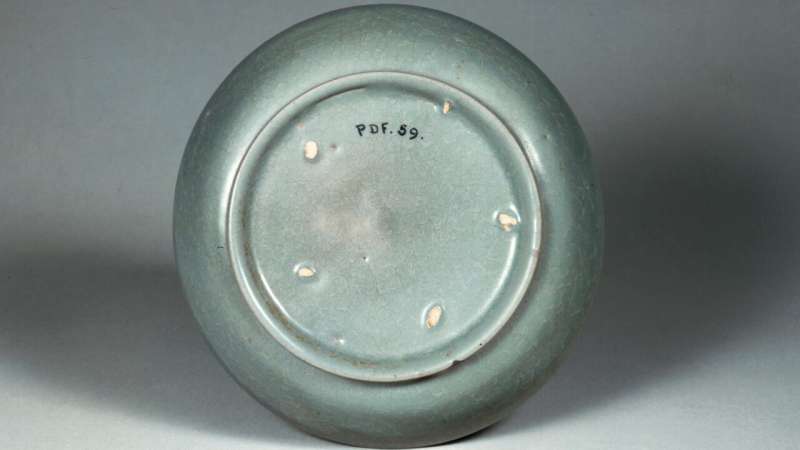
For decades, a small green-glazed dish in a collection of Chinese ceramics carried a Korean identification. It was an entirely respectable label for an object whose smooth surface resembled celebrated Korean celadons. But one specialist kept looking at the dish and saw a different possibility.
The object, known in research as PDF.59, had been bought in New York in 1928 by the collector Sir Percival David. He came to believe it belonged to China’s exceptionally rare Ru wares. Later scholars disagreed, and the Korean attribution stayed with it for roughly half a century.
In 2021, a new study brought David’s old idea back into view. The dish had not been dug out of the ground or discovered in a forgotten box. Its story changed because researchers looked again at an object that was already there.
A small dish with a complicated label
The brush washer is just under 15 centimetres wide. Its shallow form could hold water for a calligrapher’s brushes, but its simple shape does not announce where it was made. Its most striking feature is the green glaze covering the surface.
David built a major collection of Chinese ceramics that has been displayed at the British Museum since 2009. The dish had passed through different identifications even during his lifetime. A later research paper says it first entered his collection as a Korean piece, before David himself catalogued it as Ru. A 2021 account from Cranfield University says he believed it was Ru when he acquired it; the precise sequence of his early opinions is therefore less clear than the fact that he championed the Chinese attribution.
By around the 1970s, the Korean identification had returned, although the precise timing is uncertain. The alternative was not an implausible one. Korean potters had also made fine green-glazed stoneware, and the two traditions could produce vessels whose appearance was difficult to distinguish at a glance.
An object can sit beside other ceramics for years while its catalogue entry quietly shapes how visitors understand it. In this case, the same small dish seemed to tell a different national story depending on the name beneath it.
Why the Ru kiln was difficult to identify
The question of Ru ware had its own longer history. Surviving examples associated with the Northern Song court were uncommon, and researchers had spent decades trying to establish where they had been made. A useful clue came not from a famous palace collection but from the ground around Qingliangsi in Henan.
According to Henan Museum, Palace Museum researcher Feng Xianming and colleagues found a fragment there in 1977. Tests comparing it with a Ru piece in the Palace Museum produced closely matching results. In 1986, a complete glazed wash bowl found near the village drew the attention of ceramics enthusiast Wang Liuxian, who showed it to specialists at a meeting in Xi’an.
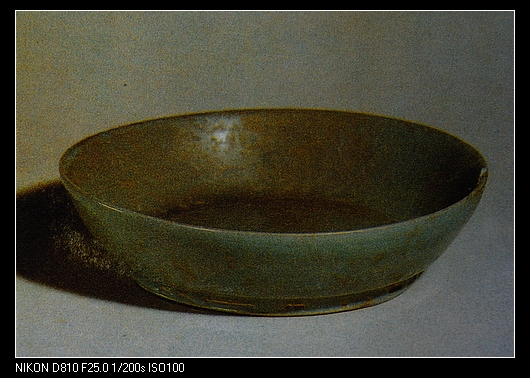
Image Source: Henan Museum. This is the Qingliangsi find, not the British Museum dish.
The bowl prompted further investigation. Shanghai Museum researchers examined finds from the area, and archaeologists carried out trial excavations in 1987. The work helped establish Qingliangsi as a production site for Ru ware associated with the Northern Song court.
That history matters to PDF.59 because identification depends on comparison. Museum pieces, excavated fragments and documented kiln sites give researchers evidence to work with. The Qingliangsi bowl was not the dish in London, and it did not by itself decide the London object’s identity.
What made a researcher look again at PDF.59?
Decades after the kiln investigations, Chinese ceramics specialist Regina Krahl was studying another Ru brush washer in Dresden. To compare it with related forms, she examined washers in the Percival David Collection. Among them was PDF.59, the dish that had been catalogued as Korean for decades.
Krahl proposed that this washer, too, was Ru. Her assessment came from looking carefully at the object and comparing it with other pieces. It did not mean that a green glaze alone was a reliable label: the appearance of Ru and Korean Goryeo wares could be close enough to invite disagreement.
The suggestion gave the museum and the collection’s trustees a new question. Could the glaze provide evidence that would support one attribution over the other without damaging the dish?
The object was intact, so the researchers needed a way to investigate it without breaking off a sample. They turned to scientists at Cranfield University and a portable X-ray fluorescence instrument, often abbreviated to XRF.
How the glaze helped researchers reconsider the dish
The instrument allowed the team to examine the glaze without removing a piece of it. Instead of judging colour alone, researchers compared measurements from PDF.59 with those from ten Ru vessels and ten Korean Goryeo vessels in the collection.
The resulting measurements were not a photograph of a kiln or a record naming the potter. They offered a way to compare elements in the glazes of objects already attributed to the two groups. The researchers found that PDF.59 grouped with the Ru examples in their analysis, supporting Krahl’s visual and historical assessment.
The published study reports differences between the comparison groups, including in measurements associated with manganese and strontium. Other comparisons showed some overlap. The conclusion was strongest as an assessment of this dish against the specific objects examined, rather than a promise that a single reading can identify every green-glazed ceramic.
Andrew Shortland, director of Cranfield Forensic Institute, described the value of the collaboration: “There is great potential for art historians, curators and scientists to work together to confirm the attribution of important problem pieces.”
His point reaches beyond the machine. The test became meaningful because specialists had already assembled the comparison objects and asked a precise question about PDF.59. The scientific results and the close study of form supported one another.
What changed when the washer became Ru again?
The 2021 announcement returned the dish to the Ru category its collector had championed. It did not uncover a new vessel; it changed the way an existing one could be understood in relation to the other Northern Song objects around it.
The reattribution also brought the dish’s collecting history into focus. David had acquired it nearly a century earlier, and for much of that time its identity had not been settled. Krahl’s renewed attention and the Cranfield comparison did not replace that history of disagreement—they became another chapter in it.
There are still questions the glaze cannot answer. The measurements cannot name the person who owned the washer in the Song dynasty, describe every stage of its firing or reconstruct its journey to the New York market. Even a strong comparison should not be mistaken for a complete biography.
But the change in label is more than a correction on a museum card. It connects a dish acquired by one collector, the long search for a kiln site and a later encounter between ceramic history and scientific analysis. A small object that once seemed to sit comfortably in one category now carries the story of how researchers learned to look at it again.
References
- British Museum. (n.d.). [Collection record for object PDF.59]. https://www.britishmuseum.org/collection/object/A_PDF-59
- Cranfield University. (2021, October 20). Cutting-edge forensic analysis identifies rare ceramic dish for the British Museum. https://www.cranfield.ac.uk/press/news-2021/cutting-edge-forensic-analysis-identifies-rare-ceramic-dish-for-the-british-museum
- Delbey, T., Hall, J. H., Sheaf, C., & Shortland, A. J. (2022). Characterising Chinese Ru ware in the Sir Percival David collection at the British Museum using handheld XRF analysis. Advances in Archaeomaterials, 3(2), 86–91. https://doi.org/10.1016/j.aia.2023.04.001
- Henan Museum. (n.d.). Ru-kiln azure-glazed goose neck vase with engraved designs. https://www.chnmus.net/sitesources/hnbwy/page_pc/WeeklySelection/Ru-KilnAzure-glazedGooseNeckVasewithEngravedDesigns/list1.html